Website Speed Is Key to Your Success

7. 9. 2026
ATWEL specialist
Categories: online store, Web application development, Website Development, WordPress website management
According to research, more than half of all website visitors expect a page to load in under 2 seconds.
The reality, however, is quite different. Many websites take far longer to load. It’s perfectly common to wait 5 or 7 seconds for a page to appear — or even more.
It’s not your internet connection. It’s simply that the website isn’t built properly. That not enough attention was paid to speed optimisation.
Neglected Website Maintenance Affects Speed
One of the top reasons for slow page load times is neglected website care and maintenance.
Many businesses, once someone finishes building their website, consider the job done. “Now it’ll just run itself.” They forget that launching a website is only the first step toward business success.
Even well-designed websites need ongoing maintenance — both in terms of content and on the technical side. Many tools today allow everyday website users to make all sorts of changes to their site themselves. But they don’t always have the full knowledge of what those changes might cause. That’s understandable.
The problem tends to surface precisely when you, as the site owner, need your website most. When demand is growing and people are visiting your site — perhaps because of an ad campaign you’ve invested in.
And then it turns out the website can’t keep up. Visitors give up waiting for the page to load and leave. The money you put into advertising goes to waste.
Good Websites Have a Dedicated Manager
This is often not just one person within the company responsible for the website, but frequently an entire team focused on this work. If your website runs on WordPress, technical WordPress management is about more than knowing how to install a plugin or configure it in the admin panel. You also need to be able to look “under the hood” and know how to develop for WordPress. Keep that in mind when choosing who manages your site.
The Wrong Type of Content Slows Your Pages Down
If you want to drive visitors away from your website, use the highest-quality images you have. Sounds contradictory? It is, but it’s true.
Even if you want to showcase the best photos you have, hold back. It’s not necessary. Full-resolution photographs are completely unnecessary for websites.
Mobile screens and computer monitors don’t have high enough resolution to make it worthwhile putting images around 4,000 pixels wide on your site. On top of that, those image files are enormous. Your visitors won’t wait for them to load. They’ll leave and they won’t come back. You’ve lost a potential customer.
Always Resize Images for the Web
Both in resolution and file size. Never use photos at their original resolution.
A great solution is to integrate a function into your website that automatically optimises and adjusts images, ensuring that the most appropriate size of any given image is always displayed.
This is another area where a company that handles your website’s technical matters can help. And if you don’t have one, find one: ideally someone you can work with on an ongoing basis. Looking for someone new every time is time-consuming. On top of that, each new person tends to add their own touch, and making sense of it all afterwards can get quite complicated.
The Wrong Solution for Your Website or E-shop
Today there are plenty of ready-made systems that any regular user can install and have their own website up and running. Popular options include content management systems like WordPress, Drupal, Joomla, and others. But these systems are suited to specific types of websites.
WordPress CMS, for example, is excellent for content-driven websites, which is exactly why it’s called a content management system. However, it’s not an ideal solution for e-commerce. It can work as a starting point when you need to get an online shop off the ground. But once your website starts generating real financial results, it’s worth asking whether it’s still the right tool for the job.
WordPress Has Its Limits
We frequently deal with requests to speed up WordPress-based websites. We once had a case where a page was loading in 18 seconds. Yes — it was an e-commerce solution built on WordPress with the WooCommerce plugin.
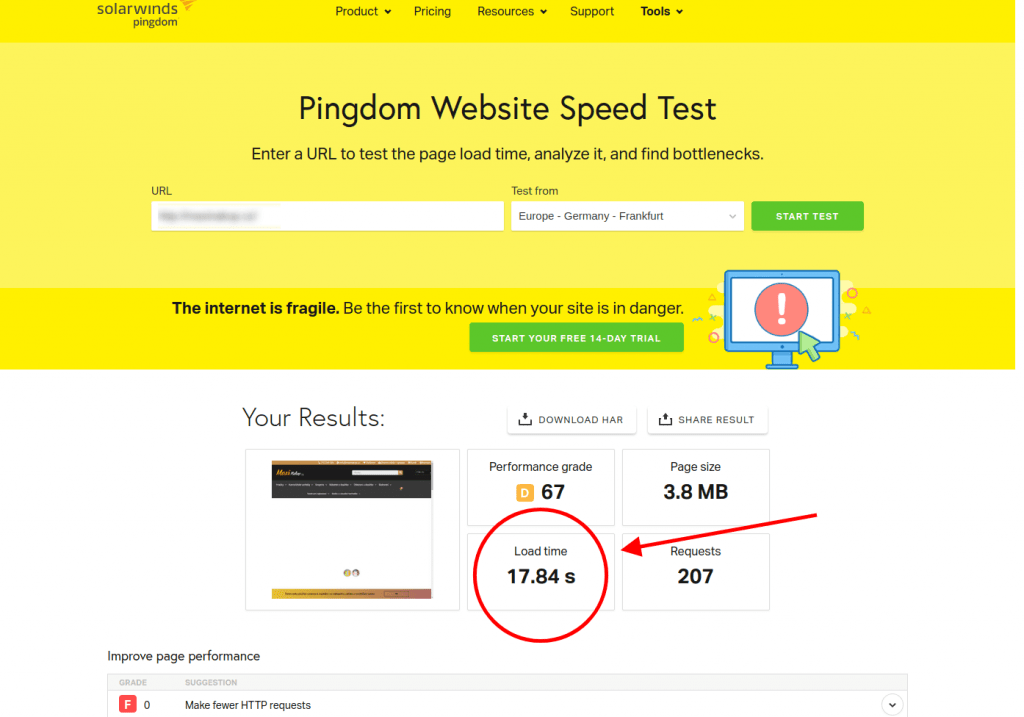
After our intervention, we managed to identify the issue and stabilise the load time. We brought it down to a very respectable figure of around 3.5 seconds. However, that’s still not under 2 seconds.
For comparison: custom-built web solutions load in under 1 second. They may seem like the more expensive option. But if you calculate how much revenue such a project can generate, you’ll find that the benefits outweigh the costs. It simply pays off.
If your website is generating CZK 100,000 in monthly revenue (approximately €4,000), it’s time to start thinking about the future. A custom solution is the way to significantly increase what your website earns.